|
|
INDUSTRIAL RELATIONS
Industrial relations can be regarded as the relationships and interactions in the labour market between employers and employees (and their representatives), and the intervention in these relations by governments, government agencies and tribunals (e.g. the Australian Industrial Relations Commission).
Historically, governments have regulated the Australian labour market to varying degrees. Changes to the structure or processes underpinning the industrial relations environment have generally followed changes in governments, and periods of social or economic change. For most of the last century, employee-employer relationships were shaped by highly centralised Commonwealth and state tribunal-based systems of conciliation and arbitration. However, since the late-1980s, the industrial relations environment in Australia has undergone significant change and is now characterised by more decentralised arrangements.
The field of industrial relations is complex and diverse and, for statistical purposes, is not easily measured. The ABS collects information on a number of topics to provide an insight into the state of the industrial relations environment, including industrial disputes, trade union membership, and the methods used for setting pay (i.e. awards, collective agreements and individual arrangements, see How pay is set).
INDUSTRIAL DISPUTES
In ABS statistics, an industrial dispute is a disagreement over an issue or group of issues between an employer and its employees, which results in employees ceasing work. Industrial disputes comprise: strikes, which are a withdrawal from work by a group of employees; and lockouts, which are a refusal by an employer or group of employers to permit some or all of their employees to work.
This section presents statistics on industrial disputes involving work stoppages of ten or more working days lost. Working days lost refers to working days lost by employees directly and indirectly involved in the dispute. Directly involved employees are those who actually participated in the dispute. Indirectly involved employees are those who were stood down at the location where the stoppage occurred, but who were not themselves parties to the dispute.
The number of working days lost per year, and the number of employees involved, have fluctuated from year to year, but have decreased significantly over the last two decades (graph 6.63).
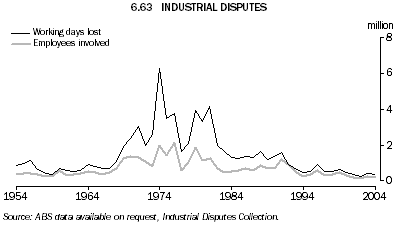
Table 6.64 shows that 379,800 working days were lost in 2004, a decrease of 14% from 2003. Over the same period the total number of employees involved in industrial disputes fell by 30% to 194,000. While there were more disputes in 2004 than in 2003 (692 compared with 643), the average number of working days lost per dispute decreased, from 683 in 2003 to 549 in 2004.
6.64 INDUSTRIAL DISPUTES
|
 | Disputes | Employees involved | Working days lost | Working days lost per dispute |
| no. | ’000 | ’000 | no. |
|
| 1999 | 731 | 461.2 | 650.6 | 890 |
| 2000 | 700 | 325.4 | 469.1 | 670 |
| 2001 | 675 | 225.7 | 393.1 | 582 |
| 2002 | 767 | 159.7 | 259.0 | 338 |
| 2003 | 643 | 275.6 | 439.4 | 683 |
| 2004 | 692 | 194.0 | 379.8 | 549 |
|
Source: ABS data available on request, Industrial Disputes Collection. |
Table 6.65 shows that the number of working days lost per thousand employees decreased from 54 in 2003 to 46 in 2004. The coal mining industry had the highest number in each year from 1999 to 2004, although the 295 working days lost per thousand employees in 2004 was considerably less than the number recorded in 1999 (1,432). The construction industry had the second highest number of working days lost per thousand employees in 2004 (224), followed by other mining (118). The industries which recorded the largest decreases between 2003 and 2004 were other mining (down from 330 to 118) and metal products, machinery and equipment manufacturing (down from 215 to 72).
6.65 WORKING DAYS LOST PER THOUSAND EMPLOYEES, By industry
|
| 1999 | 2000 | 2001 | 2002 | 2003 | 2004 |
| ANZSIC Division | no. | no. | no. | no. | no. | no. |
|
| Mining | | | | | | |
| Coal | 1,431.9 | 2,070.4 | 1,154.3 | 361.8 | 375.1 | 294.5 |
| Other | 35.9 | 63.1 | 32.9 | 19.6 | 330.1 | 117.5 |
| Manufacturing | | | | | | |
| Metal products; Machinery and equipment | 283.2 | 173.1 | 269.2 | 92.2 | 214.9 | 71.7 |
| Other | 131.0 | 120.8 | 149.4 | 82.7 | 59.6 | 34.1 |
| Construction | 379.0 | 239.0 | 280.2 | 224.6 | 248.6 | 223.7 |
| Transport and storage; Communication services | 59.4 | 77.4 | 39.4 | 54.2 | 53.7 | 37.9 |
| Education; Health and community services | 149.0 | 71.0 | 7.0 | 3.1 | 76.1 | 81.8 |
| Other industries(a) | 6.9 | 8.7 | 7.1 | 8.7 | 4.9 | 10.0 |
| All industries | 87.3 | 61.0 | 50.4 | 32.5 | 53.7 | 45.5 |
|
| (a) Includes: Agriculture, forestry and fishing; Electricity, gas and water supply; Wholesale trade; Retail trade; Accommodation, cafes and restaurants; Finance and insurance; Property and business services; Government administration and defence; Cultural and recreational services; and Personal and other services. |
|
| Source: ABS data available on request, Industrial Disputes Collection. |
TRADE UNION MEMBERSHIP
A trade union is defined as an organisation, consisting predominantly of employees, whose principal activities include the negotiation of rates of pay and conditions of employment for its members. In August 2004 there were 1.8 million employees who were trade union members in their main job, a 1% decrease on the number recorded in August 2003. As shown in table 6.66 this represents 23% of all employees. The public sector has a higher rate of unionisation, with 46% of employees having trade union membership, compared with 17% in the private sector. A slightly higher proportion of men than women are trade union members (24% compared with 22%).
6.66 TRADE UNION MEMBERSHIP - August 2004
|
| Males | Females | Persons |
| Sector | % | % | % |
|
| Public | 49.6 | 44.1 | 46.4 |
| Private | 19.2 | 15.1 | 17.4 |
| All sectors | 23.5 | 21.7 | 22.7 |
|
Source: Employee Earnings, Benefits and Trade Union Membership, Australia, August 2004 (6310.0). |
Trade union membership in Australia experienced growth throughout much of the 20th century, peaking at 61% in 1962 (graph 6.67). Between 1962 and 1970 trade union membership declined rapidly. This was followed by increasing membership during the 1970s. However, since then the proportion of employees who were trade union members has steadily declined.
Some of the factors contributing to the decline in trade union membership include the changing workplace relations environment and the changing industry composition of the labour market. These changes include declines in employment levels in traditionally highly unionised industries and the emergence of industries that are not highly unionised. Another factor in the decline in trade union membership is the increase in part-time and casual employment. These types of employment have historically been less unionised than full-time employment.
The level of trade union membership varies considerably across industries, with the Electricity, gas and water supply (52%), Education (44%), Government administration and defence (37%), and Transport and storage (36%) industries being the most unionised in 2004 (graph 6.68). The least unionised industries were Agriculture, forestry and fishing (5%), Property and business services (7%), Wholesale trade (8%), and Accommodation, cafes and restaurants (8%).
Between 1999 and 2004 most industries experienced a drop in their rate of unionisation. The largest declines occurred in the more unionised industries, with the proportion of employees who were trade union members falling in the Communication services industry (from 48% to 29%), Mining (from 35% to 17%), and Finance and insurance (from 28% to 17%). The Electricity, gas and water supply, Cultural and recreational services, and Agriculture, forestry and fishing industries were the only industries to experience an increase in the proportion of trade union members.
|

 Print Page