NATIONAL INCOME, EXPENDITURE AND PRODUCT ACCOUNTS
The Australian national income, expenditure and product accounts are compiled and published each quarter, in ABS Australian National Accounts: National Income, Expenditure and Product (5206.0), and in greater detail once a year, in ABS Australian System of National Accounts (5204.0).
GDP account
The GDP account indicates changes in Australian economic activity over time. Table 30.3 shows annual time series from 2003-04 to 2007-08. Table 30.4 shows expenditure on GDP in volume terms.
In volume terms (i.e. after the effects of price change are removed from the dollar value of Australia's production) GDP recorded a growth rate of 3.7% in 2007-08. This was higher than the 3.3% recorded in the previous year.
30.3 GDP ACCOUNT, Current prices |
|
 | | 2003-04 | 2004-05 | 2005-06 | 2006-07 | 2007-08 |
| | $m | $m | $m | $m | $m |
|
| Final consumption expenditure | | | | | |
| General government | 150 378 | 162 499 | 173 139 | 186 205 | 200 129 |
| Households | 492 681 | 521 028 | 547 458 | 584 875 | 626 793 |
| Total final consumption expenditure | 643 059 | 683 527 | 720 597 | 771 080 | 826 921 |
| Gross fixed capital formation | | | | | |
| Private | 183 059 | 197 385 | 220 823 | 238 948 | 269 851 |
| Public | 30 701 | 34 354 | 39 939 | 45 758 | 50 201 |
| Total gross fixed capital formation | 213 760 | 231 739 | 260 762 | 284 707 | 320 052 |
| Changes in inventories | 6 036 | 5 000 | 612 | 2 652 | 4 694 |
| Gross national expenditure | 862 854 | 920 266 | 981 972 | 1 058 438 | 1 151 668 |
| Exports of goods and services | 147 219 | 167 562 | 196 274 | 215 695 | 234 862 |
| less Imports of goods and services | 168 714 | 190 188 | 210 794 | 228 452 | 254 783 |
| Statistical discrepancy(a) | - | - | - | - | 425 |
| Gross domestic product | 841 351 | 897 642 | 967 454 | 1 045 674 | 1 132 172 |
| Compensation of employees | 400 124 | 431 118 | 464 511 | 501 011 | 539 020 |
| Gross operating surplus | 264 078 | 284 467 | 312 417 | 338 626 | 373 684 |
| Gross mixed income | 78 358 | 80 260 | 83 064 | 93 151 | 97 495 |
| Total factor income | 742 560 | 795 845 | 859 992 | 932 788 | 1 010 199 |
| Taxes less subsidies on production and imports | 98 791 | 101 800 | 107 458 | 112 886 | 121 672 |
| Statistical discrepancy(b) | - | - | - | - | 301 |
| Gross domestic product | 841 351 | 897 642 | 967 454 | 1 045 674 | 1 132 172 |
|
| - nil or rounded to zero (including null cells) |
| (a) Expenditure-based. |
| (b) Income-based. |
| Source: ABS Australian System of National Accounts, 2007–08 (5204.0). |
30.4 EXPENDITURE ON GDP, Volume measures(a)(b) |
|
| | 2003-04 | 2004-05 | 2005-06 | 2006-07 | 2007-08 |
| | $m | $m | $m | $m | $m |
|
| Final consumption expenditure | | | | | |
| General government | 170 057 | 176 447 | 180 839 | 186 205 | 192 582 |
| Households | 524 580 | 547 884 | 562 093 | 584 875 | 606 435 |
| Total final consumption expenditure | 694 560 | 724 303 | 742 908 | 771 080 | 799 017 |
| Gross fixed capital formation | | | | | |
| Private | 198 166 | 209 562 | 227 868 | 238 948 | 263 571 |
| Public | 35 314 | 38 400 | 42 042 | 45 758 | 48 666 |
| Total gross fixed capital formation | 233 564 | 247 997 | 269 936 | 284 707 | 312 237 |
| Domestic final demand | 928 276 | 972 418 | 1 012 854 | 1 055 785 | 1 111 254 |
| Changes in inventories | 6 209 | 6 102 | 2 298 | 2 652 | 4 346 |
| Gross national expenditure | 933 984 | 977 468 | 1 014 831 | 1 058 437 | 1 115 600 |
| Exports of goods and services | 197 382 | 203 407 | 207 886 | 215 695 | 225 345 |
| less Imports of goods and services | 173 993 | 195 124 | 209 246 | 228 452 | 257 374 |
| Statistical discrepancy(c) | - | - | - | - | 585 |
| Gross domestic product | 956 017 | 982 786 | 1 012 269 | 1 045 674 | 1 084 156 |
|
| - nil or rounded to zero (including null cells) |
| (a) Reference year is 2006–07. |
| (b) Volume measures for years other than 2006–07 and 2007–08 are not additive. |
| (c) Expenditure-based. |
| Source: ABS Australian System of National Accounts, 2007–08 (5204.0). |
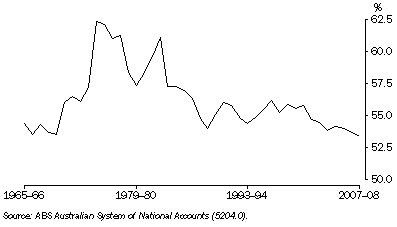
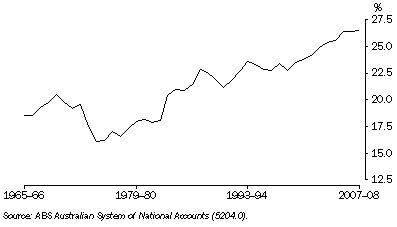
The GDP account can also be used to show changes in the share of income accruing to labour (i.e. compensation of employees) compared with the share accruing to capital (i.e. profits, defined as the gross operating surplus of non-financial and financial corporations). Graphs 30.5 and 30.6 show how the shares of total factor income accruing to wages and to profits have changed since 1965-66. (Total factor income is equal to the sum of compensation of employees, gross operating surplus and gross mixed income.)
The highest recorded value of the wages share of total factor income was 62.4% in 1974-75. The wages share in 2007-08 was 53.4%, slightly lower than the previous year (53.7%), and one of the lowest levels recorded in time series presented. The profits share of total factor income has been growing steadily since 1998-99. In 2007-08 profits share was 26.5%, the highest share recorded.
30.5 Wages share of total factor income
30.6 Profits share of total factor income
National income account
The national income account shows the sources of national income and how much of this income is spent on final consumption. That part of income which is not spent in this way is saving. Table 30.7 shows annual time series from 2003-04 to 2007-08.
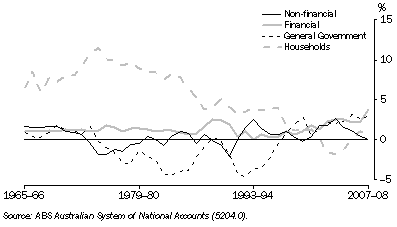
Graph 30.8 shows net saving by institutional sector as a proportion of GDP for the years 1965-66 to 2007-08. Household net saving as a percentage of GDP generally fluctuated between 6% and 8% between 1965-66 and 1971-72. It then rose to a peak of 11.5% in 1974-75. The series then gradually decreased, eventually reaching its lowest at -1.8% of GDP in 2003-04. Household net saving as a proportion of GDP remained negative until 2004-05 and since then has turned positive and in 2007-08 it was 0.4% of GDP, and household income exceeded consumption by $4.0 billion (b) (table 30.9).
General government net saving as a proportion of GDP was positive from 1965-66 to 1973-74 before turning negative from 1974-75 to 1996-97 (except for 1988-89). It has remained positive since 1997-98. In 2007-08 general government net saving was positive at 2.9% of GDP ($32.9b). In 2007-08 net saving of non-financial corporations was 0.1% of GDP ($0.6b). Net saving of financial corporations has been positive at about 1% to 2% of GDP for virtually all of its history. In 2007-08 net saving of financial corporations was 3.8% of GDP ($43.0b).
30.7 NATIONAL INCOME ACCOUNT, Current prices |
|
| | 2003-04 | 2004-05 | 2005-06 | 2006-07 | 2007-08 |
| | $m | $m | $m | $m | $m |
Income |
|
| Compensation of employees | 400 124 | 431 118 | 464 511 | 501 011 | 539 020 |
| Gross operating surplus | 264 078 | 284 467 | 312 417 | 338 626 | 373 684 |
| Gross mixed income | 78 358 | 80 260 | 83 064 | 93 151 | 97 495 |
| Taxes less subsidies on production and imports | 98 791 | 101 800 | 107 458 | 112 886 | 121 672 |
| Net primary income from non-residents | -23 840 | -33 330 | -37 670 | -45 903 | -50 197 |
| Gross national income | 817 511 | 864 315 | 929 780 | 999 771 | 1 081 674 |
| Net secondary income from non-residents | -255 | -369 | -649 | -296 | -141 |
| Gross disposable income | 817 256 | 863 946 | 929 131 | 999 475 | 1 081 533 |
Use of gross disposable income |
|
| Final consumption expenditure | | | | | |
| General government | 150 378 | 162 499 | 173 139 | 186 205 | 200 129 |
| Households | 492 681 | 521 028 | 547 458 | 584 875 | 626 793 |
| Total final consumption expenditure | 643 059 | 683 527 | 720 597 | 771 080 | 826 921 |
| Net saving(a) | 45 847 | 45 491 | 62 407 | 69 293 | 82 306 |
| Consumption of fixed capital | 128 350 | 134 927 | 146 126 | 159 102 | 172 306 |
| Total use of gross disposable income | 817 256 | 863 946 | 929 131 | 999 475 | 1 081 533 |
|
| (a) Net saving is derived as a balancing item. |
| Source: ABS Australian System of National Accounts, 2007–08 (5204.0). |
30.8 Net saving, Releative to GDP
National capital account
The national capital account shows how the saving from the national income account and consumption of fixed capital (depreciation) are used to finance gross fixed capital formation. If, as is currently the case for Australia, the nation's saving and consumption of fixed capital are not sufficient to pay for all the fixed capital needed for Australian production, the shortfall must be borrowed from overseas. The amount borrowed from overseas is shown in the national capital account as a negative entry for net lending to non-residents. Table 30.9 shows the annual time series from 2003-04 to 2007-08.
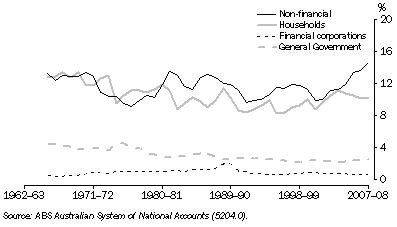
Graph 30.10 shows gross fixed capital formation (investment) by institutional sector as a proportion of GDP. Investment by non-financial corporations generally fell during the late 1970's but stablised in the 1980s and 1990s (it has generally been above 10% of GDP). In 2007-08 investment by non-financial corporations was 14.7% of GDP. Household investment as a proportion of GDP remained steady at around 10% of GDP throughout the time series and in 2007-08 the ratio to GDP was 10.3%. General government investment as a proportion of GDP peaked at 4.6% in 1975-76 and 1986-87, and has generally fallen since then to around 2.5% of GDP. It was 2.6% of GDP in 2007-08. The highest ever level of Financial corporations investment, expressed as a proportion of GDP, was recorded in 1989-90 (2.0%). It has generally fallen since and was 0.7% of GDP in 2007-08.
Graph 30.11 shows net lending by institutional sector as a proportion of GDP. A positive percentage for a sector indicates that it is a net lender to other sectors; a negative percentage indicates that it is a net borrower.
30.9 NATIONAL CAPITAL ACCOUNT, Current prices |
|
| | 2003-04 | 2004-05 | 2005-06 | 2006-07 | 2007-08 |
| | $m | $m | $m | $m | $m |
|
| Net saving | | | | | |
| Non-financial corporations | 23 011 | 14 016 | 11 689 | 4 882 | 609 |
| Financial corporations | 21 660 | 22 205 | 21 033 | 24 277 | 42 975 |
| General government | 16 546 | 21 094 | 29 522 | 28 651 | 32 894 |
| Households | -15 380 | -10 497 | 138 | 11 093 | 4 007 |
| Total net saving | 45 847 | 45 491 | 62 407 | 69 293 | 82 306 |
| Consumption of fixed capital | 128 350 | 134 927 | 146 126 | 159 102 | 172 306 |
| Net capital transfers receivable from non-residents | 1 444 | 1 523 | 1 729 | 1 960 | 2 250 |
| Gross saving and capital transfers | 175 641 | 181 942 | 210 263 | 230 355 | 256 862 |
| Gross fixed capital formation | | | | | |
| Private | 183 059 | 197 385 | 220 823 | 238 948 | 269 851 |
| Public corporations | 11 957 | 14 038 | 16 941 | 18 756 | 20 675 |
| General government | 18 744 | 20 316 | 22 999 | 27 002 | 29 526 |
| Total gross fixed capital formation | 213 760 | 231 739 | 260 762 | 284 707 | 320 052 |
| Changes in inventories | | | | | |
| Private non-farm | 6 204 | 4 761 | -386 | 2 923 | 4 625 |
| Farm and public authorities | -168 | 239 | 998 | -271 | 69 |
| Total changes in inventories | 6 036 | 5 000 | 612 | 2 652 | 4 694 |
| Acquisitions less disposals of non-produced non-financial assets | 72 | -71 | 3 | -423 | -8 |
| Statistical discrepancy(a) | - | - | - | - | 124 |
| Net lending to non-residents | -44 218 | -54 731 | -51 113 | -56 573 | -68 001 |
| Total capital accumulation and net lending | 175 641 | 181 942 | 210 263 | 230 355 | 256 862 |
|
| - nil or rounded to zero (including null cells) |
| (a) Expenditure-based discrepancy less income-based discrepancy. |
| Source: ABS Australian System of National Accounts, 2007–08 (5204.0). |
30.10 Investment, Relative to GDP
30.11 Net lending, Relative to GDP
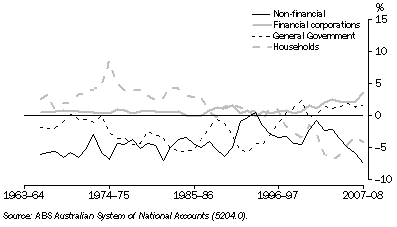
The household sector has been a net lender for most years. As a proportion of GDP, net lending by households peaked in 1974-75 at 8.4%. Since then it has trended downwards and the household sector changed from a net lender to a net borrower in 1988-89,1994-95 and 1997-98. Since 1997-98 it has been a net borrower and in 2007-08 household net borrowing was 4.1%. Non-financial corporations have been net borrowers over the entire period 1965-66 to 2007-08 (except for 1993-94), and the amounts borrowed have fluctuated significantly from year to year. As a proportion of GDP, their net borrowing was 7.4% in 2007-08.
In 2007-08 net lending of financial corporations represented 3.7% of GDP, the highest recorded level. After recording a record level of borrowing as a proportion of GDP in 1992-93 (5.7%), general government borrowing steadily declined. From 1997-98 to 1999-2000 the sector was a net lender and in 2000-01 general government was a net borrower before returning to being a net lender from 2001-02 to 2007-08. In 2007-08 general government net lending represented 1.6% of GDP.
External account
The external account is derived from the detailed balance of payments current and capital accounts (see the
International accounts and trade chapter). It shows Australia's exports and imports, incomes and transfers received by Australian residents from non-residents, and incomes and transfers payable to non-residents by Australian residents. The balance on the external account is net lending to non-residents. This is the same as the balance in the national capital account. Table 30.12 shows the external account for the last five years.
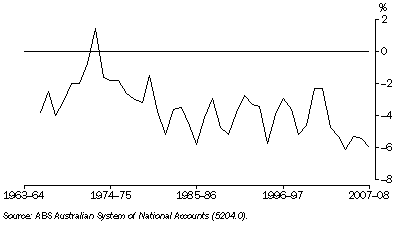
Australia has generally been a net borrower of funds from overseas. In the national accounts, this situation is reflected by a negative value for net lending to non-residents. The only exception to this pattern was in 1972-73. Net borrowing from non-residents, expressed as a proportion of GDP, increased significantly in the early-1980s and has remained at relatively high levels since then. The ratio of net borrowing from overseas to GDP in 2007-08 was 6.0%, up from 5.4% in 2006-07. Graph 30.13 shows net lending to non-residents as a proportion of GDP since 1965-66.
30.12 EXTERNAL ACCOUNT: Current prices |
|
| | | 2003-04 | 2004-05 | 2005-06 | 2006-07 | 2007-08 |
| | | $m | $m | $m | $m | $m |
Income Account |
|
| Income of non-residents | | | | | |
| Imports of goods and services | 168 714 | 190 188 | 210 794 | 228 452 | 254 783 |
| Primary income receivable | | | | | |
| | Compensation of employees | 1 906 | 1 331 | 1 563 | 1 863 | 2 302 |
| | Property income receivable | 38 935 | 53 740 | 62 581 | 80 028 | 88 524 |
| | Total primary income receivable | 40 841 | 55 071 | 64 144 | 81 891 | 90 826 |
| Secondary income receivable | 4 446 | 4 637 | 5 251 | 5 451 | 5 400 |
| Total income of non-residents | 214 001 | 249 896 | 280 189 | 315 794 | 351 009 |
| Uses of income of non-residents | | | | | |
| Exports of goods and services | 147 219 | 167 562 | 196 274 | 215 695 | 234 862 |
| Primary income payable | | | | | |
| | Compensation of employees | 1 024 | 1 127 | 1 220 | 1 309 | 1 382 |
| | Property income payable | 15 977 | 20 614 | 25 254 | 34 679 | 39 247 |
| | Total primary income payable | 17 001 | 21 741 | 26 474 | 35 988 | 40 629 |
| Secondary income payable | 4 191 | 4 268 | 4 602 | 5 155 | 5 259 |
| Balance on external income account | 45 590 | 56 325 | 52 839 | 58 956 | 70 259 |
| Total use of income of non-residents | 214 001 | 249 896 | 280 189 | 315 794 | 351 009 |
Capital Account |
|
| Balance on external income account | 45 590 | 56 325 | 52 839 | 58 956 | 70 259 |
| Capital transfers receivable | 1 127 | 1 151 | 944 | 1 035 | 1 132 |
| less Capital transfers payable | 2 571 | 2 674 | 2 673 | 2 995 | 3 382 |
| Total net capital transfers | -1 444 | -1 523 | -1 729 | -1 960 | -2 250 |
| Gross saving and capital transfers | 44 146 | 54 802 | 51 110 | 56 996 | 68 009 |
| Acquisitions less disposals of non-produced non-financial assets | -72 | 71 | -3 | 423 | 8 |
| Net lending (+) / net borrowing (-) | 44 218 | 54 731 | 51 113 | 56 573 | 68 001 |
| Total capital accumulation and net lending (+) / net borrowing (-) | 44 146 | 54 802 | 51 110 | 56 996 | 68 009 |
|
| Source: ABS Australian System of National Accounts, 2007–08 (5204.0). |
30.13 Net lending to overseas, Relative to GDP
30.14 Exports and Imports, Relative to GDP
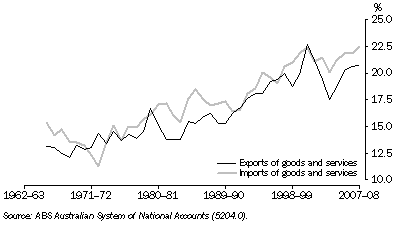
The growing importance of international trade to the Australian economy is illustrated by graph 30.14 which shows the ratios of exports and imports of goods and services to GDP in current prices since 1965-66. In 2007-08 the imports ratio was 22.5% and the exports ratio was 20.7%. Since 2000-01 imports increased 91.8.% in volume terms compared with a 15.0% growth in volume of exports.

 Print Page