TRANSPORT ACTIVITY
Domestic airline activity
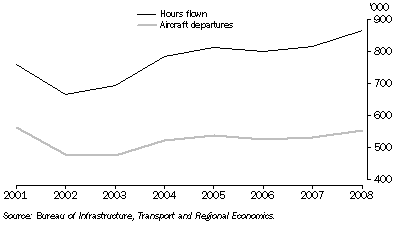
The total hours flown and the number of aircraft departures by the major domestic and regional airlines are shown in graph 24.6. In 2008 there were 868,000 hours flown, while aircraft departures totalled 556,000.
24.6 Domestic airline activity, Major and regional airlines
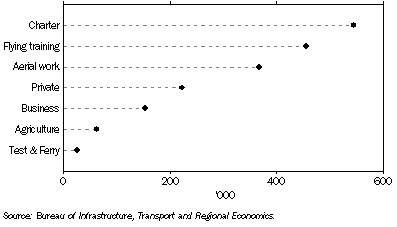
In addition to domestic and regional scheduled services, activities undertaken by the general aviation industry include private and business flying, agriculture, charter, training and test and ferry flying (graph 24.7). Charter, flying training and aerial work activity accounted for 75% of general aviation hours flown in 2007. Aerial work includes all survey and photography, spotting, stock mustering, search and rescue, ambulance, towing (including glider, target and banner towing) and other aerial work (including advertising, cloud seeding, fire fighting and coastal surveillance). Test and ferry flying is associated with the testing of an aircraft or associated with its delivery or movement to a location for maintenance, hire or other planned use. It accounted for 1% of hours flown in 2007.
24.7 general aviation activity, Hours flown
- 2007
Road transport activity
Motor vehicles travelled an estimated total distance of 215,171 million kilometres (km) in the year ended 31 October 2007, at an average of 15,300 km per vehicle (table 24.8). Business use accounted for an estimated 34% of aggregate distance travelled, and private use 66%. Of total private use travel, 37% consisted of travel to and from work, and 63% for personal and other use travel.
24.8 BUSINESS AND PRIVATE VEHICLE USE - Year ended 31 October 2007 |
|
 | Business
| | Private
|
| Type of vehicle | Laden | Unladen | Total(a) | | To and from work | Personal and other use | Total |
TOTAL DISTANCE TRAVELLED (mill. km) |
|
| Passenger vehicles | - | - | 31 902 | | 45 257 | 80 769 | 157 928 |
| Motor cycles | - | - | ^206 | | ^444 | ^1 254 | 1 905 |
| Light commercial vehicles | 17 400 | 6 491 | 23 891 | | 6 742 | 6 752 | 37 385 |
| Rigid trucks | 5 816 | 2 526 | 8 342 | | ^136 | ^166 | 8 644 |
| Articulated trucks | 5 122 | 1 798 | 6 920 | | ^7 | ^2 | 6 929 |
| Non-freight carrying trucks | - | - | ^283 | | ** - | ** - | ^283 |
| Buses | - | - | 2 003 | | ^22 | ^73 | 2 097 |
| Total | 28 338 | 10 816 | 73 548 | | 52 607 | 89 016 | 215 171 |
AVERAGE DISTANCE TRAVELLED (‘000 km)(b) |
|
| Passenger vehicles | - | - | 8.9 | | 7.6 | 8.3 | 14.3 |
| Motor cycles | - | - | ^2.9 | | ^3.3 | ^3.9 | 5.0 |
| Light commercial vehicles | 14.4 | 8.5 | 18.7 | | 8.4 | 5.9 | 18.1 |
| Rigid trucks | 17.5 | 9.8 | 24.8 | | ^4.3 | ^4.7 | 24.3 |
| Articulated trucks | 73.8 | 30.2 | 98.8 | | ^3.7 | *2.2 | 98.1 |
| Non-freight carrying trucks | - | - | ^15.3 | | **0.8 | **0.3 | ^15.2 |
| Buses | - | - | 33.4 | | ^4.6 | ^9.3 | 32.4 |
| Total | 17.6 | 10.0 | 13.6 | | 7.6 | 7.9 | 15.3 |
|
| ^ estimate has a relative standard error of 10% to less than 25% and should be used with caution |
| * estimate has a relative standard error of 25% to 50% and should be used with caution |
| ** estimate has a relative standard error greater than 50% and is considered too unreliable for general use |
| - nil or rounded to zero (including null cells) |
| (a) Includes business travel of non-freight carrying vehicles. |
| (b) Average distance travelled for registered vehicles which were used. |
| Source: ABS Survey of Motor Vehicle Use, Australia (9208.0). |
The localities in which motor vehicles travelled are described in table 24.9. Only 5% of total distance travelled represented interstate trips, while 56% of trips were within the capital city of the state or territory in which the vehicle was registered.
24.9 LOCATION OF VEHICLE OPERATION - Year ended 31 October 2007 |
|
| Within state/territory of registration
| | |
| Type of vehicle | Capital city | Provincial urban | Other areas of state/territory | Total | Interstate | Australia |
TOTAL DISTANCE TRAVELLED (mill. km) |
|
| Passenger vehicles | 94 976 | 30 799 | 26 476 | 152 250 | ^5,677 | 157 928 |
| Motor cycles | ^830 | ^481 | ^520 | 1 831 | *74 | 1 905 |
| Light commercial vehicles | 18 067 | 6 803 | 10 959 | 35 829 | ^1,556 | 37 385 |
| Rigid trucks | 4 383 | 1 328 | 2 472 | 8 183 | ^461 | 8 644 |
| Articulated trucks | 1 302 | 557 | 3 275 | 5 135 | 1 795 | 6 929 |
| Non-freight carrying trucks | ^139 | ^37 | ^82 | ^258 | **25 | ^283 |
| Buses | 1 029 | ^396 | 574 | 1 999 | *98 | 2 097 |
| Total | 120 727 | 40 400 | 44 358 | 205 485 | 9 686 | 215 171 |
AVERAGE DISTANCE TRAVELLED (’000 km)(a) |
|
| Passenger vehicles | 11.8 | 7.8 | 8.1 | 13.8 | ^6.4 | 14.3 |
| Motor cycles | 3.7 | ^4.0 | ^3.7 | 4.8 | ^3.5 | 5.0 |
| Light commercial vehicles | 15.5 | 8.7 | 12.6 | 17.6 | ^10.1 | 18.1 |
| Rigid trucks | 23.2 | 11.8 | 15.7 | 23.2 | ^20.6 | 24.3 |
| Articulated trucks | 30.0 | 18.8 | 65.2 | 74.4 | 85.3 | 98.1 |
| Non-freight carrying trucks | ^17.7 | ^8.8 | ^9.5 | 14.2 | **27.6 | ^15.2 |
| Buses | 29.3 | 21.9 | 22.4 | 31.2 | ^21.9 | 32.4 |
| Total | 12.4 | 8.0 | 9.8 | 14.7 | 8.7 | 15.3 |
|
| ^ estimate has a relative standard error of 10% to less than 25% and should be used with caution |
| * estimate has a relative standard error of 25% to 50% and should be used with caution |
| ** estimate has a relative standard error greater than 50% and is considered too unreliable for general use |
| (a) Average distance travelled for registered vehicles which were used. |
| Source: ABS Survey of Motor Vehicle Use, Australia (9208.0). |
Registered motor vehicles in Australia consumed 30,047 million litres of fuel in the 12 months ended 31 October 2007 (table 24.10). Of the total fuel consumed by motor vehicles in this period, 63% was petrol and 31% was diesel.
Passenger vehicles used 15,910 million litres of petrol in the 12 months ended 31 October 2007. This was 88% of all fuel used by passenger vehicles.
A total of 6,206 million litres of diesel was used by articulated and rigid trucks. This was 66% of all diesel used. Light commercial vehicles used 1,687 million litres which was 18% of all diesel.
The average rate of fuel consumption for all motor vehicles in the 12 months ended 31 October 2007 was 14.0 litres per 100 kilometres. Articulated trucks had the highest average fuel consumption with 54.6 litres per 100 kilometres, followed by rigid trucks with 28.5 litres per 100 kilometres and buses with 28.3 litres per 100 kilometres. The average fuel consumption rate for passenger vehicles was 11.5 litres per 100 kilometres or around 25 miles per gallon.
In March 2003, the Federal Chamber of Automotive Industries (FCAI) adopted a voluntary target aimed at progressively improving fuel consumption for new petrol passenger vehicles to an average of 6.8 litres per 100 kilometres by 2010.
In mid 2005, to reflect the need to reduce carbon emissions, a new industry target was established to reduce average carbon dioxide (CO2) emissions for all new light vehicles (less than 3.5 tonnes gross mass) to 222 grams of CO2 per kilometre by 2010. Accordingly, this target incorporates a significantly broader range of vehicles (cars, SUVs and light trucks, etc.) and all fuel types (petrol, diesel, LPG, etc.).
Over recent years there has been a continuous reduction in average new vehicle emissions. From an estimated 252 grams of CO2 per kilometre in 2002, National Average Carbon Emissions (NACE) for all new light vehicles sold in Australia for 2008 was 222.4 grams of CO2 per kilometre. This decline in carbon emissions of new vehicles places the industry well on track to achieve the target of an average of 222 grams of CO2 per kilometre by 2010.
The Government has commenced a process to review emission standards.
24.10 MOTOR VEHICLE FUEL CONSUMPTION - Year ended 13 October 2007 |
|
| Type of vehicle
| |
| Type of fuel | Passenger vehicles | Motor cycles | Light commercial vehicles | Rigid trucks | Articulated trucks | Non-freight carrying trucks | Buses | Total |
TOTAL FUEL CONSUMPTION (million litres) |
|
| Petrol | 15 910 | ^124 | 2 780 | ^25 | - | *5 | ^32 | 18 876 |
| Diesel | ^888 | - | 1 687 | 2 425 | 3 781 | ^72 | 519 | 9 372 |
| LPG/CNG/dual fuel/hybrid(a) | ^1 296 | - | ^442 | *12 | **4 | **1 | ^43 | ^1 799 |
| Total | 18 094 | ^124 | 4 909 | 2 463 | 3 785 | ^78 | 595 | 30 047 |
AVERAGE RATE OF FUEL CONSUMPTION (litres per 100 kilimetres)(b) |
|
| Petrol | 11.1 | 6.5 | 13.2 | 21.9 | - | ^22.1 | 14.5 | 11.4 |
| Diesel | 12.3 | - | 12.5 | 28.6 | 54.6 | 28.0 | 29.2 | 24.5 |
| LPG/CNG/dual fuel/hybrid(a) | 16.6 | - | 16.0 | ^26.9 | ^64.4 | *30.9 | ^44.0 | 16.7 |
| Total | 11.5 | 6.5 | 13.1 | 28.5 | 54.6 | 27.6 | 28.3 | 14.0 |
|
| ^ estimate has a relative standard error of 10% to less than 25% and should be used with caution |
| * estimate has a relative standard error of 25% to 50% and should be used with caution |
| ** estimate has a relative standard error greater than 50% and is considered too unreliable for general use |
| - nil or rounded to zero (including null cells) |
| (a) LPG is liquefied petroleum gas. CNG is compressed natural gas. |
| (b) Calculated using the total fuel consumption divided by the total kilometres travelled. |
| Source: ABS Survey of Motor Vehicle Use, Australia (9208.0). |
Graph 24.11 shows the total fuel consumption of registered vehicles for the yearly collection periods of the ABS Survey of Motor Vehicle Use for 1998 to 2007.
Between 1998 and 2007 total consumption for all types of petrol rose from 16,062 million litres to 18,876 million litres, a rise of 18%. Over the same period the consumption of diesel fuel rose from 5,840 million litres to 9,372 million litres, an increase of 60%, while the use of other fuels types fell by 10%, from 2,007 million litres in 1998 to 1,799 million litres in 2007.
24.11 total fuel consumption(a), Type of fuel(b)
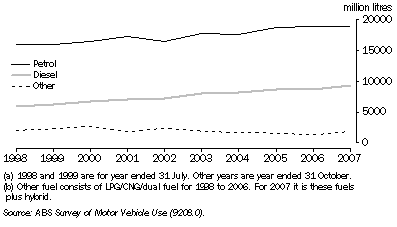
Table 24.12 shows the sales of petroleum products for Australia for the years 1988 to 2008. Sales of automotive gasoline (petrol) in 2008 totalled 18,910 million litres, an increase of 2,135 million litres or 13%, compared with total sales of 16,775 million litres in 1988.
Between 1988 and 2008 sales of unleaded petrol increased by 392%. Unleaded petrol was introduced into the Australian market at the start of 1986 to reduce the toxicity of emissions into the atmosphere from motor vehicle engines. The use of unleaded petrol allowed catalytic converters to be fitted to, and used by, the motor vehicles which were sold in Australia from 1986, as the lead in leaded petrol (used as an engine anti-knock agent and valve seat lubricant) contaminates the converter and prevents it from treating the engine's exhaust gases.
Leaded petrol was phased out in Australia as of the first of January 2002. It was replaced with the alternative lead replacement petrol (LRP), consisting of a high octane (96 RON) premium unleaded petrol containing a non-lead additive that protected against valve-seat recession. In 2002 sales of LRP were 2,051 million litres. The number of cars that require LRP has gradually reduced to the point that it has become effectively not viable for fuel suppliers to produce, store and distribute the fuel, and for service stations to retail it. This has resulted in a very limited availability of LRP, as it is being progressively phased out of the market. Sales of this fuel were 200,000 litres in 2008.
In 2005 sales of premium unleaded petrol, which can have a Research Octane Number (RON) of 95 to 98, depending on the particular product (compared with 91 for regular unleaded petrol) were 2,494 million litres, falling to 1,710 million litres in 2008.
Unleaded petrol sales accounted for 18% of total automotive gasoline sales in 1988. By 2008 unleaded petrol accounted for 77% of total automotive gasoline sales, premium unleaded 9%, proprietary brand fuel 7% and E10 fuel just under 7%. E10 is a specific fuel consisting of regular unleaded petrol blended with up to 10% ethanol (an alcohol derived from carbohydrate-rich plants such as sugar cane and corn). Federal government legislation imposes a 10% limit on the amount of ethanol in automotive petrol.
In 2008 automotive diesel oil (ADO) sales volume was 18,726 million litres, a rise of 9,360 million litres or 100% compared with 9,366 million litres of ADO sold in 1988.
24.12 SALES OF PETROLEUM PRODUCTS |
|
| Automotive Gasoline
| |
| Unleaded | Premium unleaded | Proprietary Brand | Lead replacement | E10 | Total | Automotive Diesel Oil |
| million litres | million litres | million litres | million litres | million litres | million litres | million litres |
|
| 1988 | 2 945.0 | na | na | 13 830.0 | na | 16 775.0 | 9 365.6 |
| 1989 | 4 145.0 | na | na | 13 155.0 | na | 17 300.0 | 9 994.7 |
| 1990 | 5 219.0 | na | na | 11 932.0 | na | 17 151.0 | 10 022.0 |
| 1991 | 6 022.0 | na | na | 10 858.0 | na | 16 880.0 | 9 783.9 |
| 1992 | 6 853.0 | na | na | 10 256.0 | na | 17 109.0 | 10 053.4 |
| 1993 | 7 857.0 | na | na | 9 569.0 | na | 17 426.0 | 10 538.1 |
| 1994 | 9 343.8 | na | na | 8 339.8 | na | 17 683.6 | 11 050.7 |
| 1995 | 10 297.5 | na | na | 7 451.5 | na | 17 749.0 | 11 453.5 |
| 1996 | 11 186.0 | na | na | 6 781.5 | na | 17 967.5 | 12 133.4 |
| 1997 | 11 982.2 | na | na | 5 914.5 | na | 17 896.7 | 12 574.1 |
| 1998 | 12 888.0 | na | na | 5 123.1 | na | 18 011.1 | 12 616.9 |
| 1999 | 14 028.7 | na | na | 4 374.6 | na | 18 403.3 | 13 207.1 |
| 2000 | 14 751.3 | na | na | 3 406.7 | na | 18 158.0 | 12 877.9 |
| 2001 | 15 795.6 | na | na | 2 636.1 | na | 18 431.7 | 13 274.3 |
| 2002 | 16 832.5 | na | na | 2 051.3 | na | 18 883.8 | 13 720.1 |
| 2003 | 18 198.9 | na | na | 1 406.4 | na | 19 605.3 | 14 258.8 |
| 2004 | 18 283.5 | 773.6 | na | 840.8 | na | 19 901.3 | 14 803.4 |
| 2005 | 15 885.4 | 2 493.6 | 585.6 | 154.7 | 12.1 | 19 131.4 | 15 387.3 |
| 2006 | 15 934.9 | 1 794.0 | 1 157.3 | 0.5 | 151.3 | 19 038.0 | 16 464.3 |
| 2007 | 15 623.7 | 1 843.7 | 1 406.7 | 0.1 | 495.2 | 19 369.5 | 17 550.7 |
| 2008 | 14 502.6 | 1 710.4 | 1 388.5 | 0.2 | 1 308.5 | 18 910.2 | 18 725.7 |
|
| na not available |
| Source: Department of Resources, Energy and Tourism - Australian Petroleum Statistics. |
Transport passenger activity
Personal travel occurs for many reasons, including school, business, recreation and travel to and from work. While road transport accounts for the majority of domestic passenger trips undertaken, rail services are used by a considerable number of urban commuters. Air services provide for a large proportion of long distance passenger travel.
Road passenger vehicle activity
In the year ended 31 October 2007 Australia's 12 million registered passenger vehicles travelled an estimated 158 billion (b) km (table 24.13), each averaging 14,300 km per year. Around 508,600 motor cycles travelled 2 b km, while the fleet of just over 66,000 buses travelled 2 b km.
24.13 MOTOR VEHICLE USE, By state/territory of registration - 2007(a) |
|
| Passenger vehicles | Motor cycles | Buses |
TOTAL DISTANCE TRAVELLED (mill. km) |
|
| New South Wales | 47 771 | ^582 | 547 |
| Victoria | 44 037 | ^382 | 452 |
| Queensland | 30 954 | *550 | 488 |
| South Australia | 10 684 | ^106 | 127 |
| Western Australia | 17 448 | ^195 | ^341 |
| Tasmania | 3 356 | *39 | 43 |
| Northern Territory | 1 043 | ^18 | 63 |
| Australian Capital Territory | 2 635 | ^31 | 36 |
| Australia | 157 928 | 1 905 | 2 097 |
NUMBER OF VEHICLES(b) |
|
| New South Wales | 3 470 965 | 132 787 | 17 403 |
| Victoria | 3 077 139 | 122 825 | 14 474 |
| Queensland | 2 237 720 | 124 518 | 15 417 |
| South Australia | 925 709 | 36 264 | 4 054 |
| Western Australia | 1 256 998 | 68 223 | 9 355 |
| Tasmania | 279 524 | 10 969 | 2 021 |
| Northern Territory | 76 111 | 4 408 | 2 621 |
| Australian Capital Territory | 195 048 | 8 632 | 984 |
| Australia | 11 519 214 | 508 626 | 66 330 |
|
| ^ estimate has a relative standard error of 10% to less than 25% and should be used with caution |
| * estimate has a relative standard error of 25% to 50% and should be used with caution |
| (a) Year ended 31 October 2007. |
| (b) The average number of vehicles registered for the twelve months. Includes registered vehicles that did not travel during the year. |
| Source: ABS Survey of Motor Vehicle Use, Australia (9208.0). |
Rail passenger activity
The passenger operations of rail operators are shown in table 24.14. Between 2005-06 and 2006-07 urban heavy rail and urban tram/light rail passenger journeys increased by 5% and 3% respectively, while total non-urban passenger journeys increased by 20%. Heavy rail accounted for 79% of urban rail passenger journeys in 2006-07.
24.14 RAIL PASSENGER OPERATIONS |
|
| Urban
| | |
| Heavy rail | Tram and light rail | Total | Non-urban | Total |
| mill. journeys | mill. journeys | mill. journeys | mill. journeys | mill. journeys |
|
| 2005-06 | 501 | 133 | 634 | 9 | 643 |
| 2006-07 | 529 | 137 | 666 | 11 | 677 |
|
| Source: Australasian Railway Association Inc. |
Domestic air passenger activity
At 31 December 2008 four major domestic airlines operated in Australia - Qantas, Virgin Blue, Jetstar and Tiger Airways. Regional airlines such as Regional Express Airlines (REX), Brindabella Airlines, Northwest Regional Airlines and others provided connecting services to regional airports. There were 188 security regulated airports in Australia at the end of 2007.
Passenger departures were 7% higher in 2008, compared with 2007 (table 24.15), while the percentage of vacant seat-kilometres rose from 20% in 2007 to 22% in 2008. In 2008 domestic airlines accounted for 89% of total Australian domestic passenger departures, and regional airlines 11%.
24.15 DOMESTIC AIRLINE ACTIVITY |
|
| | | 2007 | 2008 |
|
| Passenger departures(a) | | | |
| Domestic airlines | '000 | 40 919 | 44 135 |
| Regional airlines | '000 | 5 826 | 5 723 |
| Total | '000 | 46 745 | 49 857 |
| Other activity (domestic airlines only) | | | |
| Revenue passenger-kilometres(b) | mill. | 50 315 | 54 132 |
| Seat-kilometres available(c) | mill. | 62 201 | 68 604 |
| Percentage of vacant seat-kilometres | % | 20.1 | 22.1 |
|
| (a) The unit of measurement is traffic on board (which includes transit traffic). Includes revenue passengers only. |
| (b) The sum for all flights of the number of revenue passengers travelling on each flight stage multiplied by the distance between airports. |
| (c) The sum for all flights of the number of seats available on each flight stage multiplied by the distance between airports. |
| Source: Bureau of Infrastructure, Transport and Regional Economics. |
The number of domestic passenger movements at the top 10 airports in Australia is shown in table 24.16. In 2008 all these principal airports recorded increases in passenger movements compared with 2007. The strongest growth was recorded in Darwin (17%), followed by Gold Coast (13%) and Hobart and Perth (both 10%). The lowest growth was recorded in Cairns (4%).
24.16 DOMESTIC PASSENGER MOVEMENTS(a), Top 10 Australian airports |
|
| 2007 | 2008 |
| Airport | '000 | '000 |
|
| Sydney | 21 801 | 22 700 |
| Melbourne | 18 271 | 19 990 |
| Brisbane | 14 107 | 14 705 |
| Perth | 6 108 | 6 708 |
| Adelaide | 5 963 | 6 316 |
| Gold Coast | 3 736 | 4 209 |
| Cairns | 3 304 | 3 434 |
| Canberra | 2 735 | 2 984 |
| Hobart | 1 664 | 1 831 |
| Darwin | 1 362 | 1 598 |
|
| (a) The number of passengers on board arriving at or departing from each airport. Includes passengers in transit, who are counted as both arrivals and departures at airports through which they transit. |
| Source: Bureau of Infrastructure, Transport and Regional Economics. |
International air passenger activity
Passengers arriving or departing Australia primarily travel by air.
Of total international passengers (23 million) carried to and from Australia in 2008, 5 million travelled between Australia and New Zealand and 4 million travelled between Australia and Singapore (table 24.17).
24.17 SCHEDULED INTERNATIONAL PASSENGER TRAFFIC TO AND FROM AUSTRALIA - 2008 |
|
| Inbound | Outbound | Total |
| Country to/from | '000 passengers | '000 passengers | '000 passengers |
|
| Argentina | 27.7 | 26.4 | 54.0 |
| Brunei | 74.1 | 73.0 | 147.2 |
| Canada | 74.9 | 76.3 | 151.2 |
| Chile | 38.7 | 42.3 | 81.0 |
| China (excl. SARs & Taiwan) | 344.9 | 319.0 | 663.9 |
| Cook Islands | 0.7 | 0.7 | 1.3 |
| Fiji | 301.1 | 292.5 | 593.6 |
| Germany | 54.3 | 54.7 | 109.1 |
| Guam | 11.3 | 11.3 | 22.5 |
| Hong Kong (SAR of China) | 1 026.0 | 943.0 | 1 969.0 |
| India | 31.2 | 27.8 | 59.0 |
| Indonesia | 408.9 | 415.6 | 824.5 |
| Italy | 1.6 | 1.4 | 3.0 |
| Japan | 629.6 | 624.0 | 1 253.6 |
| Korea, Republic of (South) | 244.2 | 239.8 | 484.0 |
| Malaysia | 571.0 | 574.1 | 1 145.1 |
| Mauritius | 37.3 | 34.0 | 71.3 |
| Nauru | 1.5 | 1.3 | 2.7 |
| New Caledonia | 74.4 | 74.5 | 148.9 |
| New Zealand | 2 567.3 | 2 566.1 | 5 113.3 |
| Papua New Guinea | 91.3 | 95.1 | 186.5 |
| Philippines | 97.9 | 92.5 | 190.4 |
| Singapore | 2 101.9 | 1 993.8 | 4 095.7 |
| Solomon Islands | 17.9 | 19.6 | 37.6 |
| South Africa | 137.8 | 120.8 | 258.7 |
| Tahiti | 17.9 | 18.9 | 36.8 |
| Taiwan | 113.4 | 112.9 | 226.3 |
| Thailand | 701.3 | 663.0 | 1 364.2 |
| Tonga | 11.5 | 11.1 | 22.6 |
| United Kingdom | 376.6 | 377.5 | 754.1 |
| United Arab Emirates | 640.6 | 626.8 | 1 267.4 |
| United States of America | 842.3 | 843.0 | 1 685.3 |
| Vanuatu | 65.2 | 65.0 | 130.2 |
| Vietnam | 126.6 | 128.3 | 255.0 |
| Western Samoa | 17.9 | 17.9 | 35.8 |
| Total | 11 881.1 | 11 584.1 | 23 465.3 |
|
| Source: Bureau of Infrastructure, Transport and Regional Economics. |
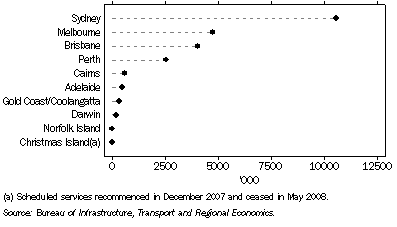
Graph 24.18 shows the number of international passengers who travelled through each of Australia's international airports in 2008. Sydney's share of total international passenger traffic was 45%, followed by Melbourne (20%), Brisbane (17%) and Perth (11%).
24.18 international passengers, Australian international airports
- 2008

 Print Page